
Shift toward Automation & AI-led Digital Transformation
- The industry is increasingly focusing on automation and AI. Routine tasks — regulatory coding, reporting, maintenance, repetitive operations — are being automated. This means companies are doing more with fewer people, and redeploying workforce toward higher-value tasks or AI-oriented functions.
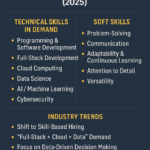
- As a result, demand is rising for people with strong skills in AI/ML, data, cloud, cybersecurity, full-stack development, and other advanced domains — rather than just Basic or legacy IT skills.
• Cost Pressures & Economic Uncertainty
- Global macroeconomic headwinds and cost optimization pressures have pushed many companies to restructure and cut workforce.
- This has led to widespread layoffs — both in traditional “tech” firms and service-based IT companies.
Reality: Layoffs & Slower Hiring in 2025
- 2025 has seen a dramatic wave of layoffs worldwide: over 1 lakh (100,000+) tech jobs were eliminated across many companies.
- Many firms are reducing hiring—especially for junior positions, operations, and support roles.
- For example, in India too the IT services industry is seeing layoffs and role rationalizations due to skill mismatches, automation and shifting client demands.
- Some earlier optimistic projections about hiring and growth have been tempered by global slowdown and structural shifts.
Implication: If you are targeting a job or moving within IT, it’s no longer enough to rely on generic IT skills — specialization and constant upskilling are becoming more important.
Still Much Opportunity — Particularly for Skilled & Specialized Talent
Despite layoffs and slowdowns, the overall outlook remains cautiously optimistic for 2025–2026:
- Some reports predict that the Indian IT sector could generate hundreds of thousands of new jobs this year — especially in high-demand areas.
- Companies are reframing — moving away from mass hiring to selective hiring for niche, high-value roles.
- Organizations investing in innovation, product engineering, cloud/AI services, digital transformation — those verticals see sustained demand.
Takeaway: The best opportunities today lie in skilled, future-oriented roles — cloud engineers, AI/ML, DevOps, data science, cybersecurity, product engineering, etc.
What It Means for You (Given Your Background)
Given that you are preparing for a senior developer role with skills in PHP/Laravel/Node.js/React/Flutter — you’re relatively well-positioned IF you adapt to the changing industry’s needs:
- Stay updated in modern stacks (cloud integration, microservices, APIs, DevOps), not just traditional LAMP/MVC.
- Consider expanding into emerging areas: cloud-native development, backend for AI/data-driven apps, DevOps/CI-CD pipelines — skills in demand as companies modernize.
- Highlight strong fundamentals (code quality, design patterns, system design, architecture) plus flexibility — these help even in a “leaner hiring” environment.
- Be ready for continuous learning (new frameworks, languages, tools) — the industry is no longer static.
Key Risks & What to Watch Out For
| Risk/Trend | What to Keep in Mind |
|---|---|
| Job cuts / layoffs | Relying purely on older or commodity-level skills increases risk of layoffs. |
| Reduced hiring volume overall | Entry-level and traditional support roles may see fewer openings. |
| Skill mismatch | Need to constantly upgrade to relevant tech (cloud, AI, data, modern stacks). |
| Global outsourcing shifts | With changing visa & foreign-hiring policies abroad, Indian IT firms also under pressure; competition increases. |
Conclusion — It’s a Time of Transition, Not Collapse
The IT industry in 2025 is going through a strong restructuring: automation + global uncertainties + evolving client demands have shaken the old norms of mass hiring and long-term job security.
But this also opens up new opportunities — for those who evolve, specialize, and build future-oriented skills.
For someone with your background and willingness to learn — this transition can mean greater scope, more challenging projects, and better career growth — if you adapt proactively.